

Can Aps Shut Off Service In Summer
If Arizona Public Service hadn't cut off her electricity terminal September, Stephanie Pullman might yet be alive today.
On August 23, 2018, the utility mailed a warning alphabetic character to the 72-year-one-time's home in Sunday City W, where she lived with her true cat, Cocoa. Pullman owed APS $176.84, information technology said. She had five days to pay in full. Otherwise, APS would disconnect the electricity. Exterior, temperatures were in the triple digits.
Pullman lived on less than $1,000 a calendar month in Social Security, according to i of her daughters, Jeanine Smith. Her children regularly chipped in to help with expenses. When their mother'due south air conditioner broke in Apr 2018, they made sure it was fixed. Smith, who lives in Ohio, paid her female parent's phone bill; her sister, Chris Hotes, covered the internet.
APS didn't cut off Pullman'southward electricity on August 28. Pullman's final electric bills bear witness that on September five, 2018, the 24-hour interval after her Social Security bank check unremarkably arrived, she paid APS $125.
It wasn't enough. Two days later, on September 7, APS disconnected her electricity. That twenty-four hour period, temperatures hitting at least 105 degrees Fahrenheit, instruments recorded in nearby Youngtown showed. Smith recalled it was 107 degrees.

Stephanie Pullman
Courtesy of Stephanie Pullman's family
One week later, alarmed that she and her sister hadn't heard from their female parent, Hotes called the Lord's day City Due west Posse, a local group that conducts health checks. The posse alerted people at the Maricopa County Sheriff's Office, who entered the business firm to notice Pullman in her bed.
The house had no air-conditioning, because it had no electricity. Pullman's body was already decomposing, the coroner's report said. The medical examiner wrote that her death occurred by "environmental estrus exposure in setting of significant cardiovascular disease."
People from the sheriff's function noticed signs of a cat, but Cocoa was nowhere to be plant.
Smith said she believed her female parent did non know that her electricity was about to be disconnected. If Pullman had known, she would have asked for assist paying the bill, and her children would take freely given it, Smith said.
"We would've never permit her power exit," said Smith. "Never."
The cost of cooling
Dr. Vjollca Berisha, senior epidemiologist with the Maricopa County Department of Public Health, calls rut "a silent killer."
"You lot never know when it's going to strike yous," she said. "You never know how much you can take."
Heat is not subversive in the dramatic manner of a tornado or an earthquake. Nor is its damage as visible or as stunning. If an elderly person's air conditioning breaks in the middle of July, who, from the outside, tin can tell?
The danger of oestrus is also the kind of complex problem that, by virtue of existence everybody'due south responsibility, somehow becomes no ane's responsibility.
"What can nosotros do as a society?" Berisha mused. "As a social club, we take to get organized."
Community-based groups need to effigy out how to target and attain people who need help, she said. "I know a lot of people are working on it, but they are working in silos," Berisha added.
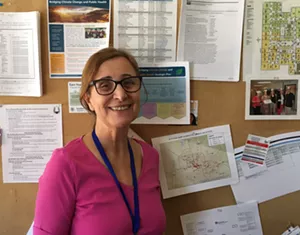
Dr. Vjolla Berisha
Elizabeth Whitman
In 2015, the Department of Public Health took the atomic number 82 on a coalition called Bridging Climatic change and Public Health, a collection of 28 different groups aimed at addressing climate-related wellness risks, including heat. And then far, it has produced a strategic plan. Its long-term impact remains to be seen.
The group has no funding, Berisha said. "We are just operating based on goodwill and people who are really ready to donate their time," she said.
Since the county began tracking heat-related deaths in 2006, the information, spread out annually, resemble a roller coaster that arches a little college with each successive hill. In the last 3 years, the number of people in Maricopa County who died because of heat has exploded. In 2016, 154 died from heat-related causes. In 2017, that rose to 179.
Last year, 182 people died, in some way or another, considering of the heat. Of those, 119 deaths were caused direct by the heat. In the remaining 63, estrus was a contributing factor.
Merely whether oestrus is the direct cause or not, the data also shows that socioeconomic factors are as powerful predictors of death by rut. People who are older, poorer, or isolated are at the greatest risk, canton data shows.
In 2018, 35 pct of heat-related deaths were among homeless people. Heat-related deaths among Native Americans (four out of every 100,000 people) is twice the rate of such deaths among whites (1.viii out of 100,000); the charge per unit among African-Americans is too extremely high, at 2.viii people per 100,000. Both of these communities take higher rates of poverty than others, Berisha noted.
In Maricopa County, temperatures unremarkably start to eclipse 100 degrees Fahrenheit in mid-May, maintaining that oven-like experience sometimes well into October. A typical summertime will see 26 days with temperatures pushing past 110 degrees.
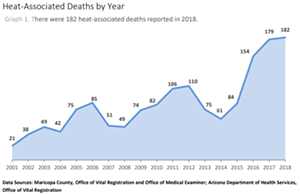
Estrus-related deaths in the canton are on the ascension.
With climate alter and urbanization, the heat in Maricopa County is worsening. Country data shows that in the Phoenix area, boilerplate minimum night temperatures rose by approximately 9 degrees from 1948 to 2000, with average daytime temperatures rise by about v.five degrees Fahrenheit.
As the county began analyzing the data information technology collected, something surprising came up. About 40 percent of the heat-related deaths were happening indoors.
"Initially, nosotros thought any [death] is rut-related is associated with the outdoors," Berisha said.
Equally they parsed medical examiner reports, death certificates, and hospital belch and other public health statistics, they found that of the deaths indoors, 80 percent were considering a person's business firm, apartment, or condo was too hot, because air conditioning did not be, or considering it didn't work. In the remaining 20 percent, the air conditioning status was unknown.
In 12 percent of the cases with nonfunctional ac, homes only had no air workout, Berisha said, sitting at her desk and scrolling through the slides of a contempo presentation she had given on heat-related deaths. Behind her was a bulletin board, tacked with printouts of graphs and charts on Maricopa County's silent killer.
In the remaining 88 percent of cases, the ac wasn't functioning. The causes: no electricity (xi percent), Air-conditioning turned off (28 per centum), or broken Air-conditioning (61 pct). Overall, 83 percent of indoor heat-related deaths happened in a abode where the ac wasn't running.
Crunch the numbers, and a cleaved air conditioner, maybe left unrepaired due to a lack of money, is a cistron in 17 per centum of all heat-related deaths. A shuttered air conditioner, perhaps turned off in an endeavour to salvage money, is responsible for 7.8 percent. And a lack of electricity, maybe because a utility disconnected a person over an unpaid neb, unpaid for lack of coin, caused iii percent of the total heat-related deaths.
Afterwards record heat-related deaths were seen in 2016, a group of local researchers, including Berisha and scientists at Arizona State Academy, analyzed a decade'south worth of data, trying to figure out why deaths had spiked. They discovered that high temperatures could not explain the surge.
"Our results indicate that factors other than the conditions were predominantly responsible for the surge in heat-associated deaths in 2016," they wrote. They couldn't explicate those factors but instead called for "further clarification of the circuitous iterations between the many social and physical determinants of risk of heat-related illness and death."
They published their results in a paper in the periodical Environmental Enquiry Letters, on September 19, 2018, five days after Stephanie Pullman was plant in her bed.
"It seems like more and more people are non able to afford to continue the air conditioning on," Berisha said. Utility companies need to cut people a break, especially during peak summer months, she said.
People like Pullman.
'You ended my mom's life for $51'
Stephanie Pullman moved to Arizona from Ohio in 1988, after her four children had graduated high school. She followed her best friend from high school out west, in role to escape the harsh Midwestern winters.
"Nosotros tried to go her to come domicile," Smith said. "She loved Arizona. She loved the conditions."
In Arizona, Pullman connected working for a hospital in the dietary department, as she had when she was raising her kids in Ohio as a unmarried mom. She loved Cocoa, the cat, and she adored her grandchildren, Smith said.
Pullman besides loved to garden and kept flowers all effectually her two-bedroom, ane,100-square-pes house in Sun Metropolis West, Smith said. Bougainvillea grew in front, and she decorated outside her house with rocks, wind chimes, and figurines of the Native American deity Kokopelli.
One of Pullman'due south favorite pastimes was visiting garage and k sales. "We used to speed up whenever nosotros saw 1, so nosotros didn't take to stop," Smith remembered with a chuckle.
Pullman retired in 2011, a month afterward she turned 65, switching to a stock-still income. The Social Security check that arrived on the 4th of every month was less than $1,000, and her electric bill consumed a startling amount of that, according to Smith.
In the summertime, "her utility bill would exist pushing $200," Smith said. Everything in the house ran on electricity, she added. "That'south what injure her."
Although her female parent was "very independent, she asked for assistance when she needed information technology," Smith said.
The last time Smith heard from her mother was on September v, 2018. In an email, Pullman thanked her daughter for paying for repairs to her phone. It said, "The phone is stock-still, thanks very much, love you, bye," Smith recalled.
Her sister, Chris Hotes, had spoken to their mother by phone a 24-hour interval earlier. Pullman asked for assist paying a water bill, and Hotes said she'd send coin. She chosen her mother again on September 7 and left her a message telling her to keep an eye out for coin in the mail.
She never heard back.
The verbal date Pullman died is unclear from the medical examiner's report. Smith said their family never received a specific engagement of decease.
From what she and Hotes could slice together from the respective bills they paid for their mother, it was sometime between September seven and September 14. Pullman terminal used her phone and net on September 7. A week later, the Sun Urban center W posse called the sheriff'south office to enter her dwelling.
A medical examiner adamant that Pullman died of cardiovascular disease, with rut and diabetes acting as "significant contributing factors," co-ordinate to the coroner's written report. It noted, too that APS had cutting off electricity on September 7. It did not include the verbal temperature in the house only mentioned that Pullman was institute "in [an] uncooled residence during period of markedly elevated environmental temperatures."
Twelve days after the sheriff's part discovered Pullman, Cocoa turned up. She had been hiding under the bed.
Smith took the true cat dwelling house with her to Ohio. She started going through her female parent'south paperwork, trying to observe out what had happened, when she noticed the disconnection notice from APS. It was the only notification Smith found.
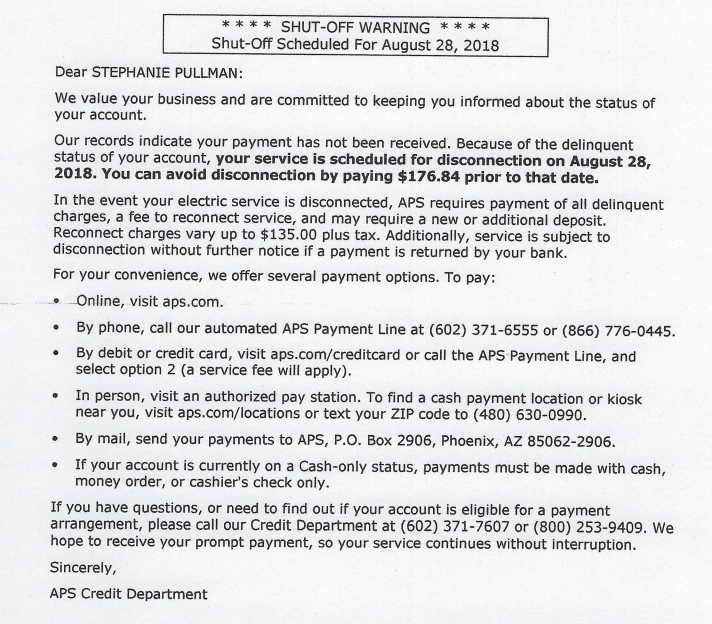
APS sent one shutoff alert to Stephanie Pullman, dated Baronial 23, 2018. Information technology gave her five days to pay her bill or lose power to her home.
Courtesy of Jeanine Smith
"Dear STEPHANIE PULLMAN," the letter read. "We value your business and are committed to keeping you informed nearly the status of your business relationship."
"Our records indicate your payment has not been received. Because of the delinquent status of your account, your service is scheduled for disconnection on August 28, 2018. You tin can avoid paying disconnection past paying $176.84 prior to that date," it said.
If APS did end up disconnecting her electricity, and Pullman wanted to reconnect it, she would take to pay up to $135 in reconnect charges, the letter said. She'd besides owe tax, perhaps a deposit, and all of her runaway charges. That bill as well tacked on new electricity charges totaling $155.ninety, for a total of $335.57 owed to APS.
Information technology's not clear why APS did not cut off Pullman'southward service on August 28, as threatened, and instead terminated her service 10 days later.
Smith said that on September 5, Pullman paid $125 of the $176.84 APS demanded in order to avoid shutoff, leaving $51.84 unpaid. The $125 payment shows upwardly, without a date, on Pullman's final APS nib, dated September fourteen.
The concluding pecker said Pullman still owed APS $287.86. That amount was a combination of her remaining balance and additional electricity charges, plus a $x.65 "field telephone call charge" from September 5.
A field call accuse is what APS charges customers in the procedure of turning off their electricity, according to a schedule filed by APS with the Arizona Corporation Commission in September 2017 and company terms and conditions.
It is incurred "when an authorized Company representative travels to the Customer's site to accept payment on a runaway business relationship, notify of service termination, make payment arrangements, or stop the service," the schedule explains.
Smith said she called the Arizona Corporation Committee, which called APS and told the utility to call Smith. "They did verify that Mom was $51 brusk, and that's why they had shut it off," she said.
"I told APS, 'You ended my mom's life for $51,'" Smith said. The person on the other end, who failed to comprehend that Smith's mother was no longer alive, replied that if she was always having trouble paying her nib, she could call and notify them, Smith said.
In October, she left a eye-wrenching review for APS on the website Consumer Diplomacy. She gave the utility one star; zero stars is not an option.
"It's not like she didn't pay anything," Smith said. "She paid $125. She all the same had to eat. She nevertheless had to buy toilet paper. She had to pay her mortgage."
"The details just fabricated me sick," Smith said.
No protections
The Arizona Administrative Lawmaking lays out when a utility can or cannot shut off service to a customer, but those rules offer few actual protections for people like Stephanie Pullman.
If a residential client cannot pay a neb, a utility can't cutting off service if the customer can provide medical documents showing that "termination would exist especially dangerous" to their health, the code says. The utility also tin't cut off service "where atmospheric condition will be especially dangerous to wellness as defined or as determined past the [Corporation] Committee."
How the Corporation Commission defines these vague circumstances — weather condition that "will be especially dangerous to wellness" — is unclear. The code doesn't contain specific temperatures or dates.
The code as well states that utilities can't shut off residential service to "ill, elderly, or handicapped persons" who can't pay their bills unless the customer "has been informed of the availability of funds from various government and social assistance agencies of which the utility is aware."
From that carefully couched phrase, it's not clear who is responsible for informing a client "of the availability of funds." Nor does the code provide clear definitions of "sick, elderly, or handicapped."
At 72, Stephanie Pullman might have qualified as elderly. She too had heart illness and Blazon Two diabetes, which might have qualified her as "ill." But the only information APS sent her about paying her bill was a warning that she was most to exist cutting off.
A spokesperson for the Corporation Committee did not answer past borderline to Phoenix New Times' questions about how the Arizona Administrative Code is enforced and whether utilities always face consequences of any kind for failing to follow the rules, even so little protection they provide to real people.
Of the ii major power providers in Maricopa County, the Corporation Commission regulates — and state code applies to — only one: APS. The other, Salt River Project, is a quasi-municipality and thus considered a political subdivision of the country.
Asked to provide a written policy of when it will or will not cut off a person'due south electricity, APS cited rules from the Arizona Administrative Code, including those described higher up. Jill Hanks, a spokesperson for the visitor, besides said in an e-mail, "APS does not disconnect service for non-payment on farthermost estrus days as adamant by weather experts."
"We apply multiple third-party weather services, including the National Atmospheric condition Service, to alarm us when weather atmospheric condition may be dangerous to a person'south health," Hanks added. The weather she provided every bit examples included temperature and consecutive days of heat, but they did not include specific figures or temperatures.
The National Weather Service issues excessive rut warnings, a regionally tailored advisory when rut is forecast to exceed local norms. The criteria vary considerably from place to place. In Maricopa County, the National Weather condition Service will outcome an excessive rut alert when temperatures are predicted to eclipse 110 degrees Fahrenheit.
Which means that if the forecast says a high of 109, and a person's electricity is nearly to be terminated, there will exist no excessive heat warning to — ironically — save them.
APS'south terms and conditions on termination loop dorsum to Arizona Administrative Code. "APS may, without liability for injury or harm, and without making a personal visit to the site, disconnect service to any Customer ... if Company has met the find requirements established past the Arizona Corporation Committee." Nowhere in those terms and conditions are any exceptions for extreme weather.
This year, a neb at the Arizona Legislature sought to change that, by creating a constabulary that would embrace all utilities and protect people from shutoffs during farthermost cold and heat. Its author, Stacey Champion, is a local activist who recently led a consumer complaint lodged at the Corporation Committee over excessive rate hikes by APS in 2017.
"Arizonans currently have no date- or temperature-based protection for utility shutoffs during extreme oestrus or cold, and this needs to exist viewed every bit the public wellness crisis information technology is," Champion said. Peculiarly in Maricopa County, air conditioning isn't a luxury, she said. "It is literally a matter of life or decease."
Senate Nib 1542, sponsored by 15 Autonomous state senators and representatives, would have barred utilities in Arizona from disconnecting service when outside temperatures were forecast to autumn below 32 degrees Fahrenheit or exceed 90 degrees. Information technology also stipulated that utilities had to brand "reasonable payment arrangements" with a customer before cut service; if the client didn't award that system, then the utility could disconnect service only when temperatures were to a higher place 32 degrees or below 90, depending on the season.
Information technology also would have unconditionally prohibited utilities from disconnecting service to a person or family if their household income fell below 200 percent of the federal poverty line and they fabricated a minimum payment, or if an elderly person, pregnant person, kid under the age of 5, or person on life support lived in the home. The nib also contained other stipulations aimed at protecting people with low incomes from being asunder.
"Seniors on fixed incomes, folks with disabilities, meaning women, those suffering from serious medical issues, and households with infants and young children specially demand to exist protected," Champion said. APS is not the just utility that is responsible for these cutoffs, she added.
Every summer, APS and SRP disconnect the electricity of tens of thousands of people living in the Valley of the Sun.
Data from SRP, which Champion obtained through a public records request and shared with New Times, show that from May through September 2018, SRP had 29,474 shutoffs. Records from SRP also showed that concluding year saw just 19 days when SRP did non disconnect residential customers "due to temperature."
SRP spokesperson Scott Harelson said that SRP does not disconnect customers on days with excessive heat warnings.
In 2018, APS cut off ability to customers more than 110,000 times, representing 79,872 unique accounts, co-ordinate to the company'southward own data. Of those, more than than 39,000 cutoffs took place during the particularly scorching months of May through September.
In response to questions about Pullman, Jenna Rowell, a spokesperson for APS, said that by police the company could not share anything near her business relationship. She said that APS was required to ship, at a minimum, one written shutoff warning to a customer, merely that it typically went "beyond that" with a phone call and a door hanger. Depending on whether or not they can get through, they'll delay the disconnect date.
Smith said she constitute but the single written notice from APS, and no door hanger. It'southward not clear if APS called Pullman, whose phone was broken for a period prior to her death. Smith was determined that if her female parent had known her electricity was well-nigh to be cut off, she would take asked for assistance.
Rowell expressed "empathy for the family" and said that APS' "height concern was that [New Times] heard from somebody nigh a family member who died." APS would be reaching out Jeanine Smith to limited condolences, she added.
Asked why APS would be doing that now, after Smith had already spoken with someone at APS soon afterward her mother's death, Rowell acknowledged that Smith had filed an informal complaint at the Corporation Commission and that "nosotros worked with her through that process."
Smith did not desire to talk to APS once more.
"In that location'due south nothing they tin do or say to change it," she said. "I simply desire policy modify."
On Midweek, APS began a temporary interruption of all disconnections for customers behind on their bills, so it could take a footstep back and re-examine its practices. The company planned to tell customers on Wednesday night and ship out a media release before long thereafter, Rowell said.
The company already had been looking at its shutoff procedures in situations with unpaid bills and extreme heat, but learning about Pullman "factored into our determination to put that [temporary intermission] into event," Rowell said.
That temporary suspension is, for now, indefinite. As this story was going to publication, Phoenix was in the midst of its first extreme heat warning. APS spokesperson Jill Hanks said that due to the rut, the visitor was already belongings off on disconnecting customers with unpaid bills this week.
Champion said the temperatures in her bill grew out of poring over medical examiner cases and noticing that people who lose air conditioning or electricity in their homes offset to die when outdoor temperatures hit 90 degrees Fahrenheit.
The nib never made it out of committee.

Can Aps Shut Off Service In Summer,
Source: https://www.phoenixnewtimes.com/news/aps-cut-power-heat-customer-dead-phoenix-summer-shutoff-11310515
Posted by: culpculoak.blogspot.com
0 Response to "Can Aps Shut Off Service In Summer"
Post a Comment