

â€⢠How Would You Design A Basic Inventory Management System For A Service Based Operation?
What Is a Service?
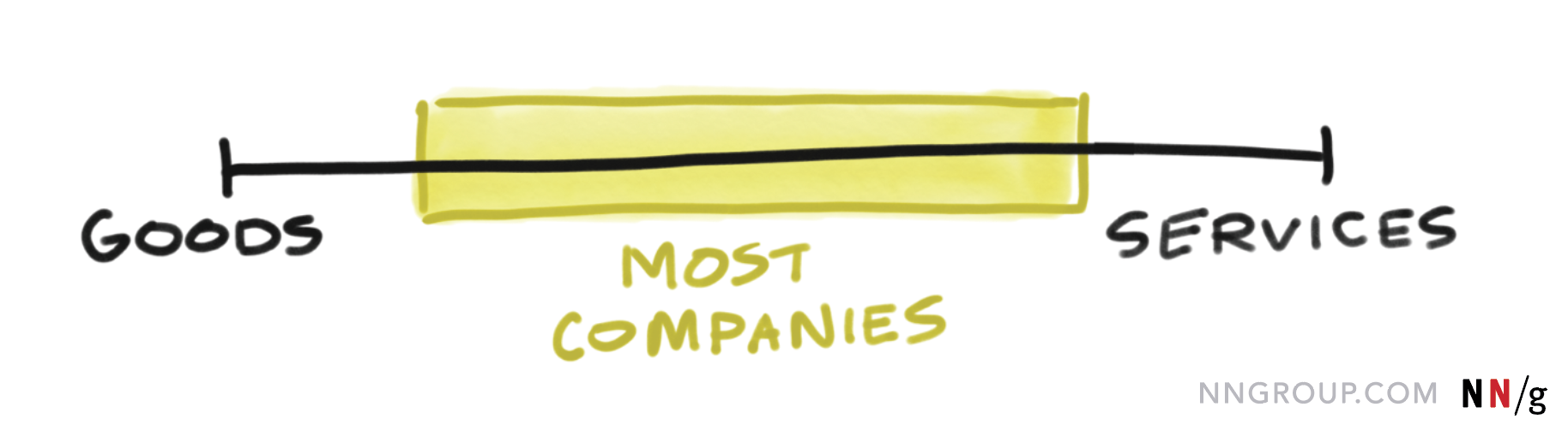
Traditional economic science draws a clear distinction between goods and services. Goods are tangible and consumable — pens, sunglasses, or shoes. Services are instantaneous exchanges that are intangible and do not result in buying—medical treatment, the post, or public transportation.
Today, there is no longer a clear distinction between appurtenances and services. A continuum of appurtenances–services exists with a plethora of combined products and services in the centre. For example, a vocal (an mp3 file) is a product that can be accessed via a service like Spotify or Apple Music. To the user, the departure between a product and service—owning the sound file versus streaming the vocal—can be close to identical while behind the scenes they are quite different.
Every bit services grow in sophistication, so does the demand to support them. Circuitous user experiences frequently suspension due to an internal organizational shortcoming — a weak link in the ecosystem. For example, when was the last fourth dimension you chosen a support hotline, gave your personal information, simply to be transferred to another amanuensis asking y'all to repeat the exact information you had already provided? This pain point stems from an internal procedure flaw that was produced by a lack of service design.
History of Service Design
The term "service design" was coined by Lynn Shostack in 1982. Shostack proposed that organizations develop an understanding of how backside-the-scenes processes interact with each other because "leaving services to individual talent and managing the pieces rather than the whole make a visitor more vulnerable and creates a service that reacts slowly to market needs and opportunities."
This is still truthful today, but the responsibility does non fall on only operations and management, every bit it did twenty years ago. Practicing service design is the responsibleness of the organization as a whole.
Definition of Service Design
Most organizations are centered around products and delivery channels. Many of the organizations' resource (time, budget, logistics) are spent on customer-facing outputs, and the internal processes (including the experience of the organisation's employees) are overlooked; service pattern focuses on these internal processes.
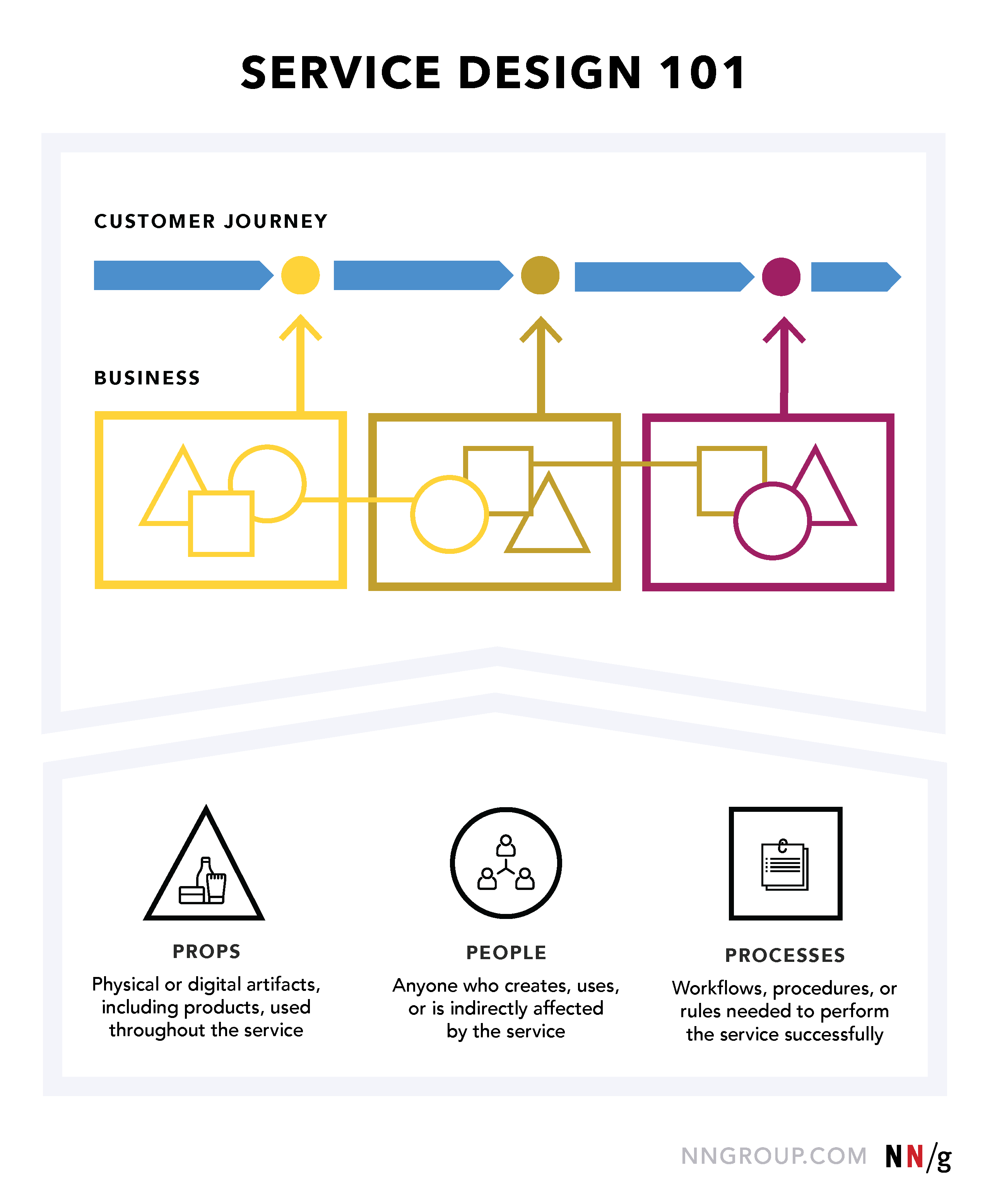
Definition: Service blueprint is the activity of planning and organizing a business's resource (people, props, and processes) in guild to (1) straight ameliorate the employee's experience, and (2) indirectly, the customer's experience.
Imagine a restaurant where there are a range employees: hosts, servers, busboys, and chefs. Service pattern focuses on how the eatery operates and delivers the food it promises—from sourcing and receiving ingredients, to on-boarding new chefs, to server-chef communication regarding a diner's allergies. Each moving part plays a role in the food that arrives on the diner's plate, fifty-fifty though it is not straight part of their experience. Service design can exist mapped using a service blueprint.
Components of 'Service Pattern'
In user experience design multiple components must exist designed: visuals, features and commands, copywriting, information architecture, and more. Non but should each component must exist designed correctly, merely they besides must be integrated to create a total user experience. Service design follows the aforementioned basic thought. At that place are several components, each one should be designed correctly, and all of them should be integrated.
The three main components of service design are:
People. This component includes anyone who creates or uses the service, besides as individuals who may be indirectly affected by the service.
Examples include:
- Employees
- Customers
- Fellow customers encountered throughout the service
- Partners
Props. This component refers to the physical or digital artifacts (including products) that are needed to perform the service successfully.
Examples include:
- Concrete space: storefront, teller window, briefing room
- Digital surroundings through which the service is delivered
- Webpages
- Blogs
- Social Media
- Objects and collateral
- Digital files
- Physical products
Processes. These are whatsoever workflows, procedures, or rituals performed by either the employee or the user throughout a service.
Examples include:
- Withdrawing coin from an ATM
- Getting an issue resolved over support
- Interviewing a new employee
- Sharing a file
Returning to the restaurant example, people would be farmers growing the produce, eating place managers, chefs, hosts, and servers. Props would include (amongst others): the kitchen, ingredients, POS software, and uniforms. Processes would include: employees clocking in, servers entering orders, cleaning dishes, and storing food.
Frontstage vs. Backstage
Service components are broken downwards into frontstage and backstage, depending on whether the customers sees them or non. Think of a theater performance. The audience sees everything in front of the drapery: the actors, costumes, orchestra, and set. Even so, backside the pall in that location is a whole ecosystem: the managing director, stage hands, lighting coordinators, and gear up designers.
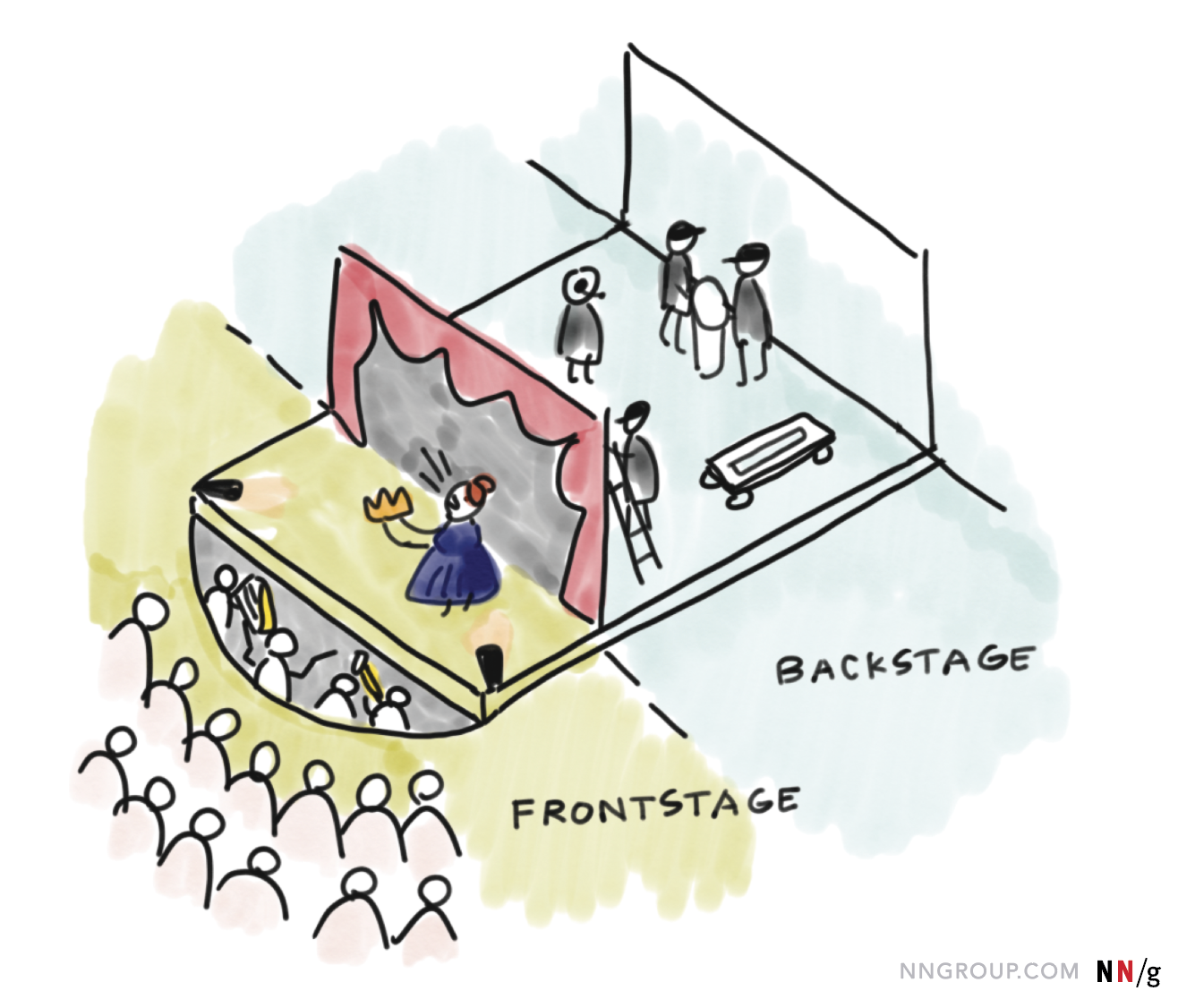
Though not ever seen by the audience, the backstage plays a critical part in shaping the audience'due south experience. In a restaurant, what happens in the kitchen dictates what appears on your table.
Frontstage components include:
- Channels
- Products
- Touchpoints
- Interfaces
Backstage components includes:
- Policies
- Applied science
- Infrastructures
- Systems
Service Pattern vs. Designing a Service
Service design is not but designing a service. Service design addresses how an system gets something done— retrieve "feel of the employee." Designing a service addresses the touchpoints that create a customer'due south journey — think "feel of the user."
As a parallel, every software application has a user interface, no matter how rudimentary. However, writing code that creates an interface as a bi-production would not be called a 'user interface design process'. Similarly, fifty-fifty if the user interface were created from a deliberate design process, it would not be a product of 'user experience design' unless the experience of the user is taken into account.
Why exercise we need to care about service design and the "feel of the employee" as UX Designers? An system's backstage processes (how we do things internally) have as much, if not more, impact on the overall user experience as the visible points of interaction that users see. If a server does not successfully communicate allergies to the chef, a diner could eat food with astringent consequences. If a restaurant is overcrowded, merely has a systematic procedure for immigration tables and assigning seating, customers never have to await or know its overcrowded in the first place.
Benefits of Service Pattern
Most organizations' resources (fourth dimension, upkeep, logistics) are spent on client-facing outputs, while internal processes (including the feel of the organization's employees) are overlooked. This disconnect triggers a common, widespread sentiment that 1 mitt does not know what the other is doing.
Service design bridges such organizational gaps by:
- Surfacing conflicts. Business organisation models and service-design models are often in disharmonize because business models do not always marshal with the service that the organization delivers. Service design triggers thought and provides context effectually systems that demand to be in identify in social club to adequately provide a service throughout the entire product's life cycle (and in some cases, across).
- Fostering hard conversations. Focused discussion on procedures and policies exposes weak links and misalignment and enable organizations to devise collaborative and crossfunctional solutions.
- Reducing redundancies with a bird's-eye view. Mapping out the whole cycle of internal service processes gives companies a bird'south-eye view of its service ecosystem, whether within 1 large offering, or across multiple subofferings. This process helps pinpoint where duplicate efforts occur, probable causing employee frustration and wasted resources. Eliminating redundancies conserves free energy, improves employees' efficiency, and reduces costs.
- Forming relationships. Service design helps align internal service provisions like roles, backstage actors, processes, and workflows to the equivalent frontstage personnel. To come dorsum to our initial example, with service pattern, data provided to one amanuensis should be available to all other agents who interact with the aforementioned customer.
Conclusion
When backstage problems exist, they have frontstage consequences: poor service, customer frustration, and inconsistent channels. Streamlining backstage processes improves the employees' experience, which, in turn, allows them to create a better user experience.
Learn more than about design thinking in the full-twenty-four hour period course Service Blueprinting.
References
Kalbach, Jim. "Mapping Experiences." O'Reilly Media, Inc, 2016.
Shostack, Lynn. "Designing Services that Deliver." Harvard Business Review, 1984.

â€⢠How Would You Design A Basic Inventory Management System For A Service Based Operation?,
Source: https://www.nngroup.com/articles/service-design-101/
Posted by: culpculoak.blogspot.com
0 Response to "â€⢠How Would You Design A Basic Inventory Management System For A Service Based Operation?"
Post a Comment